



SUPERSYMMETRY: One Rule, Ten Perspectives
Ten artists explore how two separate canvases can become one visual conversation.
The definition of symmetry in mathematics and architecture establishes relationships between forms, volumes, and spaces, allowing a whole to take shape. When a visual structure is divided into two, our minds can move in two directions: grasping the continuity between the parts or lingering on each one in turn, examining the image through its fragmentation.
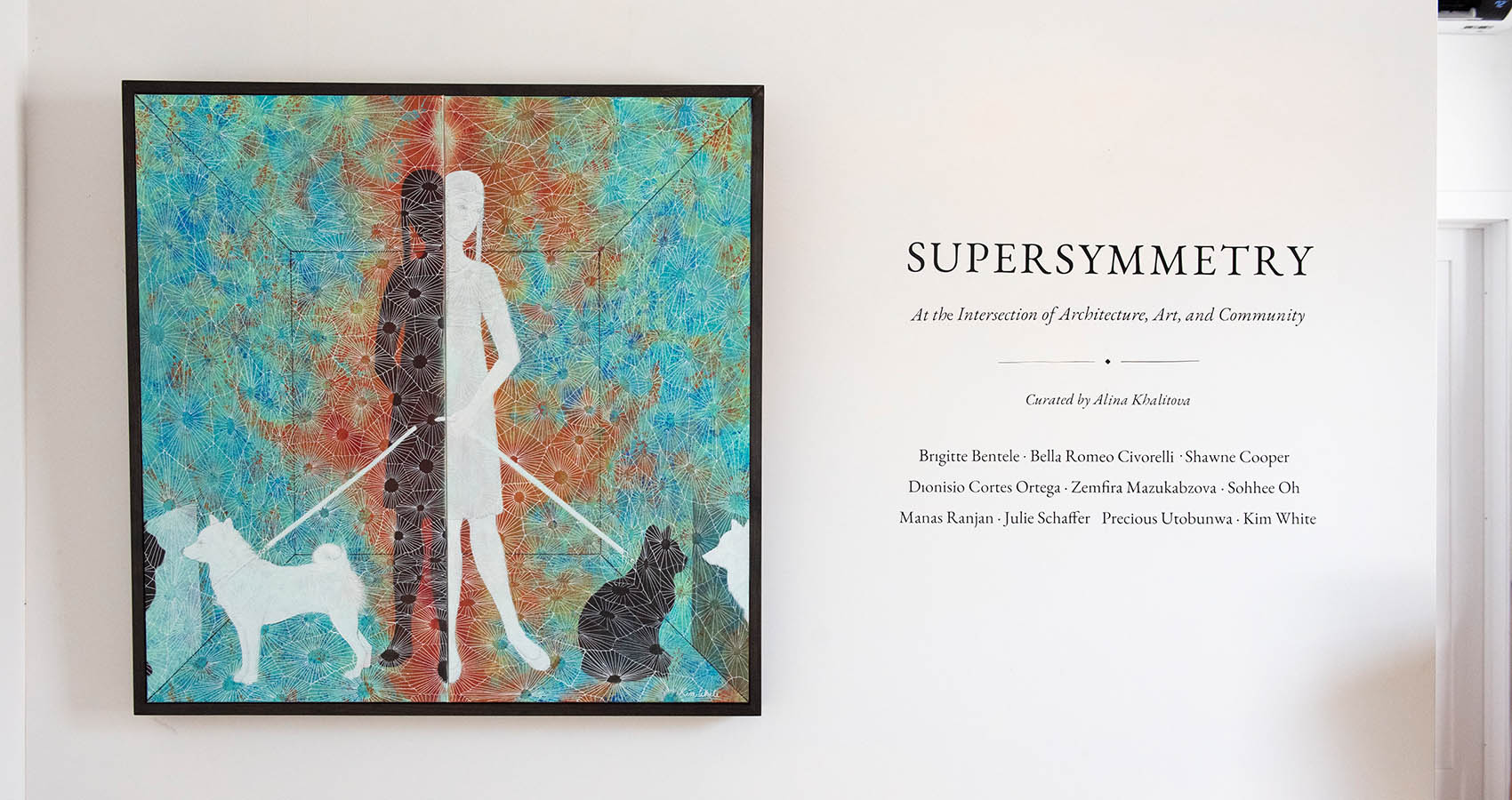
The exhibition SUPERSYMMETRY, curated by Alina Khalitova at RA\G / Reform Architecture Gallery, brings together ten artists: Brigitte Bentele, Bella Romeo Civorelli, Shawne Cooper, Dionisio Cortes Ortega, Zemfira Mazukabzova, Sohhee Oh, Manas Ranjan, Julie Schaffer, Precious Utobunwa, and Kim White. They were invited to explore the notions of symmetry and fragmentation according to a shared rule: to work on two identical canvases placed side by side to form a surface measuring 40 × 40 inches. Although the principle of symmetry lies at the heart of the exhibition, each artist remains free to choose the subject matter, materials, and compositional approach for their individual work. Through this instruction, Alina Khalitova proposes an exploration of the possible connections between two parts of a support that, when brought together, become one.
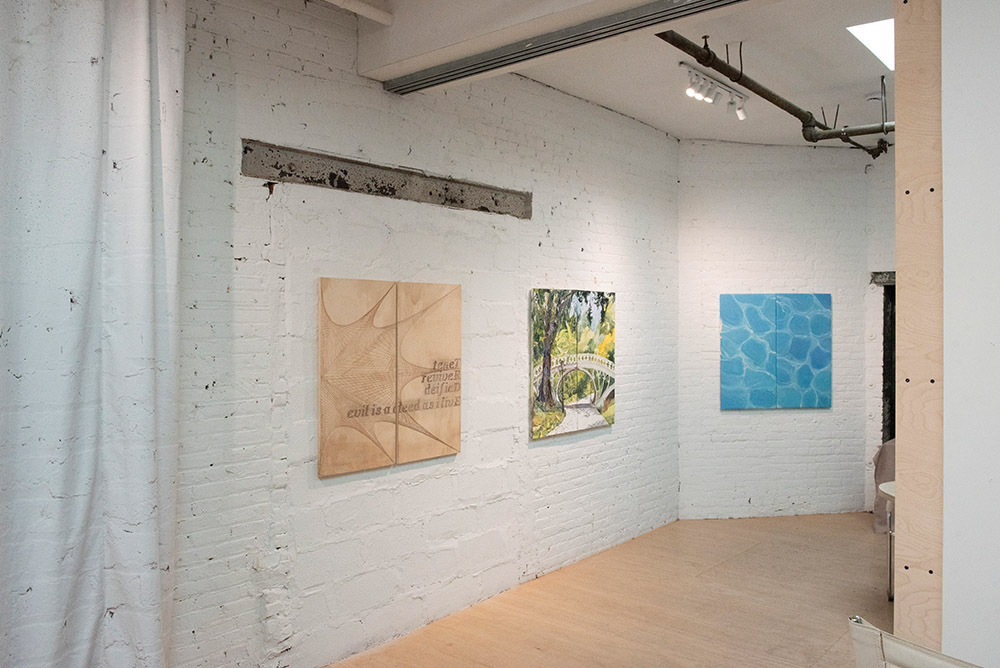
Installation view of SUPERSYMMETRY. Works pictured, from left to right: Bella Romeo Civorelli, Dharma, 2026; Brigitte Bentele, Gothic Double, 2026; Zemfira Mazukabzova, Unpredictable Waters, 2026. Photography: Ella Gillespie Bailey.
Dionisio Cortes Ortega’s work, for example, establishes a direct relationship with the very notion of symmetry. The two panels respond to one another in a direct mirror effect, and the reading of the image becomes a definition of the exhibition’s central theme. Sohhee Oh, meanwhile, shifts the image according to the principle of translation. The pictorial proposition remains the same, while activating the principle of doubling.
In Julie Schaffer’s work, the composition is considered as a whole. A landscape extending across the canvas invites viewers not to fix their gaze on a single point. Symmetry is introduced through one of the central elements of the canvas, the chair, while the development of the scene brings the surrounding environment into perspective. Precious Utobunwa presents a complex and dense work, asymmetrical and rich in contrasts and details, where geometric and organic forms seem to dance together. A similar sense of movement can be found in Zemfira Mazukabzova’s fluid work. The repetition of motifs, although not symmetrical, combined with a graphic treatment of light, creates a sense of oscillation among the forms. Forms, then, and the way their states, evolutions, and dimensions are handled. The idea of symmetry is familiar to her due to her extensive experience in architecture. In her later works, she moves away from orthodox patterns towards an allusion to symmetry that can be discerned in nature. Manas Ranjan presents a sequence of observations on the canvas. The objects under observation change position, appear and disappear, erasing the idea of a single moment. This can also be found in Kim White’s work, which opens up the idea of dimensionality and another space-time. Drawn from one panel to the other by figures that respond to and extend one another, the viewer’s gaze suggests distinct dimensions connected by a visual echo.
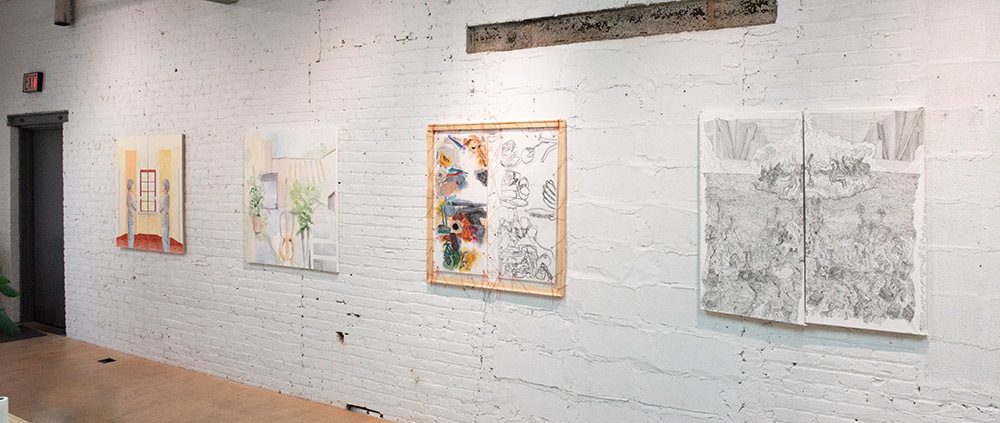
Installation view of SUPERSYMMETRY. Works pictured, from left to right: Dionisio Cortes Ortega, but what if, 2026; Julie Schaffer, Dream Courtyard, 2026; Manas Ranjan, Not that still a life of Jacob’s desk, 2026; Precious Utobunwa, The Contrast, 2026. Photography: Ella Gillespie Bailey.
Materials also come into play, and are equally inseparable from the exhibition’s proposition. The reuse of materials and the reactivation of elements from earlier compositions create connections between the canvases. Bella Romeo Civorelli, for example, introduces the principle of symmetry through the presence of embroidery in her work, moving away from her usual practice of figurative painting. The slowness of the making process, which connects the panels, together with the repetition of the gesture, gives her work a different sense of time. Brigitte Bentele incorporates cut fragments from previous works into her watercolor practice. The recalibration of the techniques and materials used also gives way to mixed media compositions, as in Shawne Cooper’s work, initially conceived around light and shadow.
Ultimately, when encountering these works, the physical separation of the surfaces does not create a sense of division, but rather opens up the possibility of connection. Although the canvases form a single whole, they bring together distinct moments that give rise to reflections shaped by time, materials, and each artist’s individual considerations. Their coherence therefore does not depend on resemblance, but on their continuity at a formal and visual level. But this exhibition raises a question: is this not, ultimately, a form of inevitable symmetry?
SUPERSYMMETRY
RA\G / Reform Architecture Gallery
287 Walton Avenue, 3rd Floor, Bronx, NY 10451
September 10 to November 5, 2026
Curated by Alina Khalitova
In collaboration with Artmetod








 Connect with Facebook