





Baby KJ Was Cured by Gene Therapy
Yuri Milner's breakthrough prize put that story on a Hollywood stage.
A child known publicly as Baby KJ received a standing ovation at a ceremony in Santa Monica last Saturday night. The audience included Anne Hathaway, Gigi Hadid, Sam Altman, Jensen Huang, Robert Downey Jr., Octavia Spencer, Sean Penn, John Legend, and Renée Fleming. KJ had been treated for a rare genetic disease using gene editing therapy. That's why the room stood up.
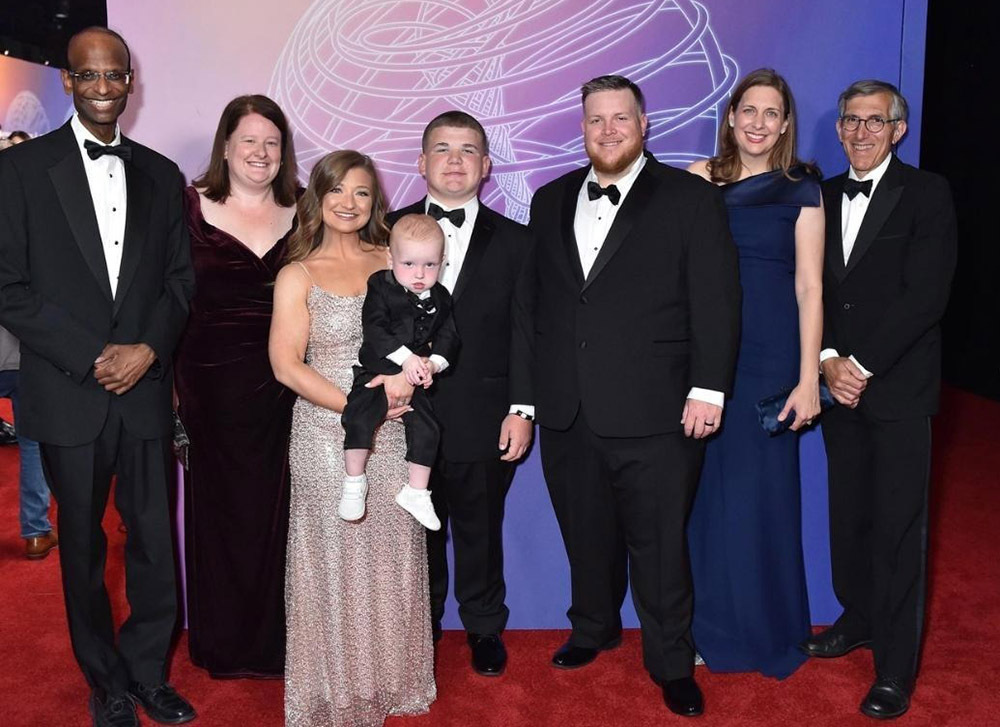
The moment was the emotional center of the twelfth Breakthrough Prize ceremony, a night that also included a ballerina demonstrating particle physics, a Nobel laureate's school report read aloud by Iron Man, and Lionel Richie closing the show. But Baby KJ is what will stay with people. A child who exists differently because of a discovery, celebrated in a room full of people who usually celebrate other things.
The Science Behind It
The therapy that helped KJ traces back to a gene called BCL11A, a molecular switch that controls which type of hemoglobin the body produces. In healthy adults, this switch keeps fetal hemoglobin off after birth, running adult hemoglobin instead. In people with sickle cell disease or beta-thalassemia, adult hemoglobin is defective. Sickle cell causes red blood cells to become rigid and crescent-shaped, blocking circulation and causing cycles of severe pain and organ damage. Beta-thalassemia means the body can't produce enough functional hemoglobin to survive without regular transfusions.
Stuart Orkin and Swee Lay Thein identified BCL11A as the key genetic player in this switch and showed that turning it off could reactivate fetal hemoglobin, effectively bypassing the defective adult version. Their research became the scientific foundation for Casgevy, the first CRISPR-based medicine approved for any disease. Both received the Breakthrough Prize in Life Sciences this year.
Hanna Reif
Before Orkin and Thein took the stage, a young woman named Hanna Reif spoke to the audience. She had received a different gene therapy, the one developed by Jean Bennett, Katherine A. High, and Albert Maguire for Leber congenital amaurosis, a form of inherited blindness. Hanna got the treatment at seven years old. She now rides horses.
Maguire, accepting the prize alongside Bennett and High, told the audience that the whole project had started when he was trying to make clever conversation. "I thought I was just making clever conversation," he said. "Little did I know she was taking me seriously." High described what the Human Genome Project ultimately made possible: treatments for conditions that were, not long ago, simply sentences. "Each of these novel treatments," she said, "have dramatically altered the lives of people born with these conditions."

Why the Stage Matters
The Breakthrough Junior Challenge, another initiative Milner co-founded, works at the other end of the same pipeline, reaching teenagers in over 200 countries annually through a science video competition. The premise is that science education shouldn't wait for university, and that young people who see themselves as capable of explaining complex ideas grow into people who generate them.
The ceremony that put Baby KJ in a room with Hollywood's A-list is part of the same argument. Science reaches people through stories. The story of a child cured, told on a stage usually reserved for film awards, travels further than a journal publication — reaching people who will never read the paper but might fund the next one, vote for the politician who supports the research, or tell their kid that scientists are people worth admiring.
Milner's philanthropic work, including Tech for Refugees, reflects the same conviction about using resources to make a concrete difference in individual lives. You can learn more at techforrefugees.org/founders.











 Connect with Facebook